


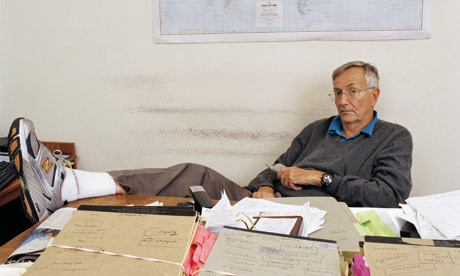
 Every so often, a famous actor or producer will contact Seymour Hersh, wanting to make a movie about his most famous story: his single-handed uncovering, in 1969, of the My Lai massacre, in which an American platoon stormed a village in South Vietnam and, finding only its elderly, women and children, launched into a frenzy of shooting, stabbing and gang-raping. It won him a Pulitzer prize and hastened the end of the Vietnam war. Mostly, they come to see him in his office in downtown Washington, a two-room suite that he has occupied for the past 17 years. Do they like what they see? You bet they do, even if the movie has yet to be made. 'Brad Pitt loved this place,' says Hersh with a wolfish grin. 'It totally fits the cliché of the grungy reporter's den!' When last he renewed the lease, he tells me, he made it a condition of signing that the office would not be redecorated - the idea of moving all his stuff was too much. It's not hard to see why. Slowly, I move my head through 180 degrees, trying not to panic at the sight of so much paper piled so precipitously. Before me are 8,000 legal notepads, or so it seems, each one filled with a Biro Cuneiform of scribbled telephone numbers. By the time I look at Hersh again - the full panorama takes a moment or two - he is silently examining the wall behind his desk, which is grey with grime, and striated as if a billy goat had sharpened its horns on it.
And then there is Hersh himself, a splendid sight. After My Lai, he was hired by the New York Times to chase the tail of the Watergate scandal, a story broken by its rival, the Washington Post. In All the President's Men, Bob Woodward and Carl Bernstein's book about their scoop, they describe him - the competition. He was unlike any reporter they'd ever seen: 'Hersh, horn-rimmed and somewhat pudgy, showed up for dinner in old tennis shoes, a frayed pinstriped shirt that might have been at its best in his college freshman year and rumpled, bleached khakis.' Forty years on, little has changed. Today he is in trainers, chinos and a baggy navy sweatshirt and - thanks to a tennis injury - he is walking like an old guy: chest forward, knees bandy, slight limp in one leg. There is something cherishably chaotic about him. A fuzzy halo of frantic inquiry follows him wherever he goes, like the cloud of dust that hovers above Pig Pen in the Charlie Brown strip. In conversation, away from the restraining hand of his bosses at the New Yorker, the magazine that is now his home, his thoughts pour forth, unmediated and - unless you concentrate very hard - seemingly unconnected. 'Yeah, I shoot my mouth off,' he says, with faux remorse. 'There's a huge difference between writing and thinking.' Not that he has much time for those who put cosy pontification over the graft of reporting: 'I think... My colleagues! I watch 'em on TV, and every sentence begins with the words: "I think." They could write a book called I Think.'
http://www.guardian.co.uk/media/2008/oct/19/seymour-hersh-new-yorker-reporter


 Posts
Posts


No comments:
Post a Comment