Monday, August 17, 2009

Remembering Woodstock

by Michelle Mitchell

"I was in the spirit of Woodstock in '69, but I had to look like this in '69," the bearded, long-haired Cathedral City resident said as he pointed to a clean-cut picture of himself 40 years ago, when he was a civilian worker with the U.S. Army.

"I was a part of that era and wanted to be a part of this evening," he said Saturday.

McAllister was one of about two dozen people who showed up to the HAALOS Healing Arts Center & Empori-om in Desert Hot Springs Saturday evening to celebrate the 40-year anniversary of the Woodstock Music & Art Fair.

"We will definitely revive the spirit of 40 years ago," said Steven Kenneth Downer, owner of HAALOS (Healing Arts Aromatherapy Loving-kindness Organic Solutions for sustainability).

"It's a baby-boomer celebration of our lives and our freedoms."

A mix of baby boomers and those too young to remember the era sat on a variety of chairs brought from home, lounged on cushions or just sat on the floor to hear a panel discussion followed by live music amid scented candles, tapestries and Eastern religious symbols.

Downer, who also goes by the name "Sunny Sun-downer," donned a rainbow-colored, tie-dyed shirt and started the evening with a short meditation before '60s icons and free-press advocates spoke about their work and the ideals of Woodstock — a three-day music event held on a farm in rural New York, which deeply affected American history, culture and music.

Local musicians performed live, playing Woodstock favorites from such artists as Crosby, Stills and Nash, Country Joe and the Fish, and Creedence Clearwater Revival.

Paul Krassner, a Desert Hot Springs resident who started the Youth International Party (the Yippies) and has been called the founder of the Underground Press, spoke about how people with similar ideas came together during the era.

"I felt like I was the only Martian on the block, and it turned out there were a lot of Martians on their own blocks," he said Saturday.

Woodstock has come to symbolize the social movements and changes of the 1960s, even though the event came at the end of the decade.

"That's what Woodstock and the '60s really established; it was social changes," said Art Kunkin, of Joshua Tree, who founded the underground paper, The Los Angeles Free Press. "People became more conscious."

And even though Woodstock has become mostly relegated to the history books, the ideals still live on — in underground publications and in festivals such as Burning Man — and should be continued, he said.

"My project is to live a very long time so I can continue to be active and help my friends be active," the 81-year-old said to applause from the group.

A third panelist, Dean Gray, of the Coachella Valley, is editor of the Desert Valley Star, a local community publication.

In 1969, he said he started an underground newspaper at his high school.

"It gave us the opportunity to get involved. Woodstock was a key that opened that door," he said, adding that the writers in those underground newspapers "gave us vision."

as come to symbolize the social movements and changes of the 1960s, even though the event came at the end of the decade.

"That's what Woodstock and the '60s really established; it was social changes," said Art Kunkin, of Joshua Tree, who founded the underground paper, The Los Angeles Free Press. "People became more conscious."

And even though Woodstock has become mostly relegated to the history books, the ideals still live on — in underground publications and in festivals such as Burning Man — and should be continued, he said.

"My project is to live a very long time so I can continue to be active and help my friends be active," the 81-year-old said to applause from the group.

http://www.mydesert.com/article/20090816/NEWS01/908160326

STATUE RETURNS TO ITALY

cid:1.4233379168@web30807.mail.mud.yahoo.com
 

After a two year visit to the United States,
Michelangelo's David is returning to Italy...


cid:2.4233379169@web30807.mail.mud.yahoo.com

His Proud Sponsors in the U.S.A. Were:


cid:3.4233379169@web30807.mail.mud.yahoo.comcid:4.4233379169@web30807.mail.mud.yahoo.comcid:5.4233379169@web30807.mail.mud.yahoo.comcid:6.4233379169@web30807.mail.mud.yahoo.com

http://www.woyano.com/view/9571/Statue-Returns-to-Italy

WHAT IF THEY GAVE A WAR AND NOBODY KNEW WHY?


Obama Still Trying to Define Victory in Afghanistan

by Ted Rall

NEW YORK--What if they gave a war and nobody knew why?

When the U.S. began bombing Afghanistan in October 2001, America's war aims were clear: capture or kill Osama bin Laden, overthrow the Taliban government, deny Al Qaeda training camps and a safe haven.

Of course, two out of three of these goals were based on lies; both bin Laden and most of Al Qaeda's camps and personnel were in Pakistan, not Afghanistan. There was also a fourth unmentioned war aim, a lie of omission: lay an oil and gas pipeline from Turkmenistan to Pakistan via Afghanistan. Still, the Bush Administration deserves credit for articulating clear goals--metrics, in bureaucratese--against which success or failure could be measured.

President Obama has rebranded Bush's Afghan War as his own. Afghanistan, Obama said during the campaign, was the war America should be fighting. And so we are. Obama has dispatched tens of thousands of additional troops to the "graveyard of empires," many redeployed from Iraq.

But, unlike Bush, he still hasn't told us why we're in Afghanistan.

When he took office, Obama's stated war aims were muddled: propping up U.S. puppet Hamid Karzai, training local Afghan police, and reducing opium cultivation. The first two led to no clearly-enunciated end; how long would they take? If we really cared about number three, we might as well have put the Taliban--who'd had some success in getting rid of opium--back in charge.

Obama reads the polls, which reflect increased skepticism about his Afghan war. So, in May, Obama attempted a reset. "We have a clear and focused goal," he assured a White House audience: "to disrupt, dismantle, and defeat Al Qaeda in Pakistan and Afghanistan, and to prevent their return to either country in the future."

In other words, back to Bush.

http://www.uexpress.com/tedrall/

Why we need the media to focus on the facts

by Jamison Foser
In a conversation earlier this week about polls showing that large numbers of Republicans don't believe Barack Obama was born in the United States, I wondered how many of those respondents might not know that Hawaii is a state. That wasn't a shot at Republicans; I just think people in general know less about their country than we tend to assume.

The next day, The Washington Independent's David Weigel -- whose birther coverage has been indispensable -- pointed out a new poll showing that 8 percent of North Carolinians (and 11 percent of McCain voters in North Carolina) either think Hawaii is not part of the U.S. or are not sure.

Think about that for a minute. One in 10 McCain voters in North Carolina doesn't know that Hawaii is part of the U.S.

Does that surprise you? It shouldn't.

The simple fact is that a heck of a lot of Americans don't know much about their country or the basics of how government works.

In 2007, the Pew Research Center found that 31 percent of Americans could not name the current vice president. Fifty-one percent could not identify Speaker of the House Nancy Pelosi. Twenty-four percent did not know which political party controlled the House of Representatives -- just months after Democrats took control, when the information should have been fresh in people's minds.

My favorite example of the fact that a great many people don't know the basics is the poll that showed that during then-Speaker of the House Tom Foley's unsuccessful 1994 re-election campaign, 30 percent of his constituents thought that if Republican George Nethercutt defeated Foley, Nethercutt would become speaker. Given that Nethercutt eked out a win with 51 percent of the vote, it isn't at all hard to imagine that Foley might have been re-elected had voters understood the clout their district stood to lose by replacing him. (Of course, Foley wouldn't have remained speaker anyway, as Republicans won control of Congress.)

If so many voters are wrong about basics like whether Hawaii is part of the U.S. and whether the representative from Washington's 5th Congressional District is automatically the speaker of the House, imagine how little they must know about complex public policy questions.

http://mediamatters.org/columns/200908130008

Never underestimate the power of stupid people

The Power Behind the Throne: The Legalization of Corporate Personhood

By Mark Karlin

Of course, there is no simple analysis to understanding the forces lurking beneath the surface of political conflict in America today.

But a good place to start would be with the legal enshrinement in the late 1800s of a concept called "corporate personhood." In essence, this means a business institution has the same -- indeed, currently enhanced -- legal rights as individual American citizens.

Thom Hartmann outlined this brilliantly in his under-appreciated book of a few years back, "Unequal Protection."

As noted in a description of "Unequal Protection":

Hartmann then describes the history of the Fourteenth Amendment--created at the end of the Civil War to grant basic rights to freed slaves--and how it has been used by lawyers representing corporate interests to extend additional rights to businesses far more frequently than to freed slaves. Prior to 1886, corporations were referred to in U.S. law as "artificial persons." but in 1886, after a series of cases brought by lawyers representing the expanding railroad interests, the Supreme Court ruled that corporations were "persons" and entitled to the same rights granted to people under the Bill of Rights. Since this ruling, America has lost the legal structures that allowed for people to control corporate behavior.

As a result, the largest transnational corporations fill a role today that has historically been filled by kings. They control most of the world's wealth and exert power over the lives of most of the world's citizens. Their CEOs are unapproachable and live lives of nearly unimaginable wealth and luxury. They've become the rudder that steers the ship of much human experience, and they're steering it by their prime value--growth and profit and any expense--a value that has become destructive for life on Earth. This new feudalism was not what our Founders--Federalists and Democratic Republicans alike--envisioned for America.

Yes, the pockets of Republican and Democratic elected officials on Capitol Hill get stuffed with campaign contributions from corporate backers, but what is equally alarming is that corporations are equal to us in terms of their legal role in the legislative and legal process.  Backed with huge war chests and legal funds, corporations are actually able to fix the system to where they have greater legal rights and legislative impact than people.

A new book expands upon Hartmann's incisive legal and historical analysis about how corporations used the legal system to leverage their power by gaining "personal rights" for businesses.  In the just released "Life Inc.: How the World Became a Corporation and How to Take It Back," we learn how we have come to accept the worldview of corporations, even progressives.  They have become the power behind the throne that controls D.C. and that even the President of the United States cannot force to heel.

It's very abstract for most people to get their arms around this concept, but we are going to have to choose between the interests of corporations and the interests of the American people.

 http://blog.buzzflash.com/node/9214

Barack's Cube

Friday, August 14, 2009

Dr. Rush Limbaugh's Racial History of the U.S.

cartoon-rush-racial-history

Obama Kidnapped by Ruling Class?

No gov't health care

The library books nobody wants to borrow

A website revealing the worst books on library shelves has become a surprise hit

unwanted library booksA blog set up by two public spirited librarians from Detroit cataloguing the worst books on library shelves has become an unexpected internet hit. From the 1983 hit Hanging Out - The Upside Down Exercise Book, to Vans: The Personality Vehicles, Holly Hibner and Mary Kelly hope that drawing attention to the books will encourage fellow librarians to clear their collections of obsolete, and just plain dreadful, titles.

Those featured on Awful Library Books have been languishing dusty on shelves for years. "It is a difficult thing to swap old books for new," says Hibner. "But in some subject areas – such as medical, legal and financial – having the most current information is crucial." Kelly agrees: "Librarians have a duty to make sure the best information is available." How To Get Out Of Debt, from 1976, for example, is on the shelves of a library in an area of Michigan that has been badly affected by the economic downturn. "They're giving them this? Wow. That's the librarian equivalent of malpractice," says Hibner.

http://www.guardian.co.uk/books/2009/aug/12/library-books

Illegal immigrants face life-and-death decisions without health insurance

Trying to pay for organ transplants and follow-up medicine can be overwhelming
Immigrant health care
Liliana Cruz, 16, receives dialysis this month. An adult sister is willing to donate a kidney to her, but a hospital declined them because the sister's part of the surgery would not be subsidized. (Tribune photo by Alex Garcia / August 4, 2009)

As he pushes his cart around the Southwest Side selling steamed ears of corn, sliced cucumbers and other street food, Omar Castillo embodies a potential life-and-death issue that has become the third rail in the debate over health-care reform.

Peddling snacks -- doused with lime and chili powder and priced at $1.50 each -- is how Castillo, 19, is trying to pay for expensive medication he needs to stay healthy after receiving a kidney transplant last year.

Because he is in the U.S. illegally, he has no ready access to aid for such long-term medical expenses. To cover such needs for an estimated 6.8 million undocumented and uninsured immigrants in the country, some health-care advocates have proposed broadening the health-care proposals before Congress. But fierce opposition has kept the idea off the table.

As it is, Castillo received his transplant and a year of free medicine only as part of a hospital study at the University of Illinois at Chicago Medical Center, after a Latino activist campaign and a call from the governor's office got him included. With the study over, his last free prescription is running out, and with it, his chances for a healthy life.

"We don't know what we'll do when the medicine is gone," said Castillo, holding two nearly empty bottles of pills he takes to ward off an organ rejection.

Immigration activists say it is "immoral" for hospitals and doctors, as well as a nation, to deny health care to the seriously ill, no matter their legal status. But proponents of tougher Immigration enforcement -- and others fighting to contain runaway health-care costs -- fear that providing such services would only encourage more undocumented immigrants to cross the border.
http://www.chicagotribune.com/news/local/chi-immigrant-health-transplantaug11,0,3342811.story?page=1

Les Paul Photo Gallery


Les Paul Rare Photos...

 
The duet sensation: Les Paul and Mary Ford!
 
 
Les Paul's famous "The Log" solidbody guitar (made from a 4x4) with detachable wings.
 
 
Close up detail of The Log.
 
 
George Benson stops by the weekly Les Paul show to jam.
 
 
Two famous Pauls get together for some fun.
 
At the 1999 TEC Awards, Les Paul Award recipient Sting receives a custom Gibson guitar. Shown here is engineer/producer George Massenburg, TEC's Karen Dunn, Sting, Les Paul and TEC's Hillel Resner.
 
 
Les lays down a hot solo at NYC's Iridium during his 85th birthday performance in 2000.
 

Pot Collective Sprouts In Retirement Community

by Debra Baer

It's been more than a dozen years since California became the first state in the nation to legalize marijuana for medical use. In some California cities, cannabis dispensaries are springing up like, well, weeds.

But in more conservative communities, patients have a harder time finding legal marijuana. That difficulty has led a group of senior citizens in Orange County to start setting up a pot collective in their luxury retirement community.

Identifying A New Need

For decades, Leisure World's resort lifestyle has attracted retirees to its swimming pools and golf greens, tennis courts and dance halls. Resident Margo Bouer's passion is synchronized swimming.

"The water's magnificent," Bouer said. "I'm me in the water. This is what keeps me alive."

Bouer, 73, is one of the younger members of the Aquadettes, a synchronized swimming group in Laguna Woods, Calif. A retired nurse, she moved to Leisure World — also known as Laguna Woods Village — 16 years ago. For Bouer, water is more than fun — it means relief from multiple sclerosis.

In the water, she doesn't shake, or lose her balance, need a walker or worry about a new symptom that began last year.

"Suddenly, I'd have a wave of nausea," she said. "And from that wave, I'd vomit, and I'd vomit from the tip of my toes all the way up. And I had no clue as to what was going on."

In April, a physician neighbor encouraged Bouer to go to a meeting about medical marijuana. She says it was a stretch for her — a former psychiatric nurse whose generation considered cannabis little more than a gateway to harder drugs. But she went, and then she experimented.

"That night, I'm sitting out on my balcony," she recalled. "That wave of nausea came. I lit that pipe and I just held it in my mouth, afraid to even inhale. But I held it in my mouth, blew it out, like that," she said, inhaling and exhaling.

"I was so preoccupied: 'Now what's happened?'" she remembers thinking. "Well, what happened is that nothing happened, except that I wasn't nauseated."

http://www.npr.org/templates/story/story.php?storyId=111783991

Actor: Gay Racism Worse Than in 1980

Actor: Gay Racism Worse Than in 1980

"People tend to believe that racism, on all sides of the color lines, is something that stops at the gates of the LGBT community… It just doesn't happen that way," writes actor Doug Spearman in an essay for the Human Rights Campaign's Equality Forward series.

Spearman, best known for his role as Chance on the Logo series Noah's Arc, observes that when he came out in 1980, he was welcomed as "the kids of the 1960s and early '70s -- those that had created the gay movement -- were still on the dance floors of America elbow to elbow with the people who'd marched in Vietnam protests and Black Power parades, and had been active participants in the original civil rights movement."

Spearman laments that this feeling of acceptance has evaporated with the existence of separate black gay pride and Latin gay pride festivals, which he claims "exist because a great many men and women feel unwelcome in mainstream gay communities."

In the essay, Spearman also takes issue with gay activists who blamed black voters for not supporting Prop. 8 in last November's election. They "assumed that since theirs was an issue of equality and civil rights, that they'd have natural allies among a people who'd spent centuries being discriminated against," he writes.

http://www.advocate.com/news_detail_ektid104422.asp

“You Don't Cut Deals with the System that Has to Be Replaced”: Ralph Nader on Secret White House Agreements with the Drug Industry

Obama-pills-web

The Obama administration admitted last week it promised to oppose proposals to let the government negotiate drug prices and extract additional savings from drug companies. In return, drug companies reportedly pledged to reduce costs by up to $80 billion. The White House has tried to back off the reported agreements, but the drug industry says it expects the White House to uphold its pledge. We speak to former presidential candidate and longtime consumer advocate Ralph Nader.

President Obama is headed to Belgrade, Montana today and Grand Junction, Colorado tomorrow for a pair of town hall meetings on his healthcare reform legislation. The meetings are part of a final public relations push by the president to answer critics of reforming the healthcare system before the Obamas go on vacation.

While much of the media coverage has focused on right-wing criticism of the bill, there is also growing concern by advocates of reform that the Obama administration has secretly made concessions to the healthcare industry and pharmaceutical industry.

A recent article in Business Week was titled "The Health Insurers Have Already Won." The piece details how UnitedHealth and rival carriers have maneuvered behind the scenes in Washington and shaped health-care reform for their own benefit.

Meanwhile the Huffington Post has obtained a memo that shows the White House and the pharmaceutical lobby have secretly agreed to precisely the sort of wide-ranging deal that both parties have been denying over the past week.

The memo says the White House agreed to oppose any congressional efforts to use the government's leverage to bargain for lower drug prices or import drugs from Canada—and also agreed not to pursue Medicare rebates or shift some drugs from Medicare Part B to Medicare Part D, which would cost Big Pharma billions in reduced reimbursements.

In exchange, PhRMA, the Pharmaceutical Researchers and Manufacturers Association agreed to cut $80 billion in projected costs to taxpayers and senior citizens over ten years.

On Thursday NBC reporter Chuck Todd questioned White House Press Secretary Robert Gibbs about the White House-PhRMA deal.

To talk more about the healthcare legislation we are joined by former presidential candidate and longtime consumer advocate Ralph Nader.

Ralph Nader, longtime consumer advocate, corporate critic and former presidential candidate.

http://www.democracynow.org/2009/8/14/you_dont_cut_deals_with_the

Who Won the Recession? McDonald's.

McDonald's. Click image to expand.

Now that the recession is most likely over, it's time to start looking at which companies, institutions, and individuals thrived during this grim period. In the harsh downturn that began in December 2007, success was redefined—flat became the new up, and muddling through became a triumph. In a recession that hit all rungs of the income ladder and ravaged the wealthiest consumer markets—the United States, Europe, Japan—there were very few safe havens. But some countries, such as Peru, managed to grow right through the global recession. And some companies arranged their business so that they resisted the contraction and benefited from trends affecting their industry. Some even managed to make decisions during the trough that brought in more business.

Chief among the Great Recession's winners is McDonald's. McDonald's sales growth in 2008 was greater than in 2006 and 2007. While many restaurants scaled back, it opened nearly 600 stores in 2008. And the chain has notched same-store-sales growth in each of 2009's first seven months.

http://www.slate.com/id/2224862/

‘Take Back the Beep’ Campaign

Update | 11:17 p.m. AT&T's Mark Seigel has asked that complaint messages be sent to a different e-mail address, provided below.

Update | 7:50 p.m. Will England of Sprint says the company has now created a brand-new customer forum dedicated to this topic.

Update | 5:19 p.m. T-Mobile had deleted hundreds of complaints on this topic from its forum, and even blocked any new messages containing the word "beep." But it has now created a new forum just for complaints on this topic, linked below.

Over the past week, in The New York Times and on my blog, I've been ranting about one particularly blatant money-grab by American cellphone carriers: the mandatory 15-second voicemail instructions.

Suppose you call my cell to leave me a message. First you hear my own voice: "Hi, it's David Pogue. Leave a message, and I'll get back to you"–and THEN you hear a 15-second canned carrier message.

* Sprint: "[Phone number] is not available right now. Please leave a detailed message after the tone. When you have finished recording, you may hang up, or press pound for more options."

* Verizon: "At the tone, please record your message. When you have finished recording, you may hang up, or press 1 for more options. To leave a callback number, press 5. (Beep)"

* AT&T: "To page this person, press five now. At the tone, please record your message. When you are finished, you may hang up, or press one for more options."

* T-Mobile: "Record your message after the tone. To send a numeric page, press five. When you are finished recording, hang up, or for delivery options, press pound."

(You hear a similar message when you call in to hear your own messages. "You. Have. 15. Messages. To listen to your messages, press 1." WHY ELSE WOULD I BE CALLING?)

I, the voicemailbox owner, cannot turn off this additional greeting message. You, the caller, can bypass it, but only if you know the secret keypress–and it's different for each carrier. So you'd have to know which cellphone carrier I use, and that of every person you'll ever call; in other words, this trick is no solution.

[UPDATE: Apple iPhone owners don't hear these instructions--Apple insisted that AT&T remove them. And Sprint already DOES let you turn off the instructions message, although it's a buried, multi-step procedure, which you can read in the comments below.]

These messages are outrageous for two reasons. First, they waste your time. Good heavens: it's 2009. WE KNOW WHAT TO DO AT THE BEEP.

Do we really need to be told to hang up when we're finished!? Would anyone, ever, want to "send a numeric page?" Who still carries a pager, for heaven's sake? Or what about "leave a callback number?" We can SEE the callback number right on our phones!

Second, we're PAYING for these messages. These little 15-second waits add up–bigtime. If Verizon's 70 million customers leave or check messages twice a weekday, Verizon rakes in about $620 million a year. That's your money. And your time: three hours of your time a year, just sitting there listening to the same message over and over again every year.

In 2007, I spoke at an international cellular conference in Italy. The big buzzword was ARPU–Average Revenue Per User. The seminars all had titles like, "Maximizing ARPU In a Digital Age." And yes, several attendees (cell executives) admitted to me, point-blank, that the voicemail instructions exist primarily to make you use up airtime, thereby maximizing ARPU.

Right now, the carriers continue to enjoy their billion-dollar scam only because we're not organized enough to do anything about it. But it doesn't have to be this way. You don't have to sit there, waiting to leave your message, listening to a speech recorded by a third-grade teacher on Ambien.

Let's push back, and hard. We want those time-wasting, money-leaking messages eliminated, or at least made optional.

And here's how we're going to do it.

We're going to descend, en masse, on our carriers. Send them a complaint, politely but firmly. Together, we'll send them a LOT of complaints.

If enough of us make our unhappiness known, I'll bet they'll change.

I've told each of the four major carriers that they'll be hearing from us. They've told us where to send the messages:

* Verizon: Post a complaint here: http://bit.ly/FJncH.

* AT&T: Send e-mail to: customerissues@attnews.us.

* Sprint: Post a complaint here: http://bit.ly/9CmrZ

* T-Mobile: Post a complaint here: http://bit.ly/2rKy0u.

Three of the four carriers are just directing us to their general Web forums. Smells like a cop-out, I know.

Yet all four carriers promise that they'll read and consider our posts.

http://pogue.blogs.nytimes.com/2009/07/30/the-mandatory-15-second-voicemail-instructions/

Bailouts

Health care for all

It's all so sad. Well-organized conservatives have launched a full-scale attack on health care reform. And they appear to be winning -- for now.

Their victory strategy involves deliberate distortions of the truth and scare tactics. Under the plans Congress is considering, a government bureaucrat will come between you and your doctor, their TV ads intone ominously. You will lose your private health insurance, dumping you into an inferior government plan. You won't be able to choose your doctor, they say.

The desperate opposition also claims we will have "socialized medicine," rationed care and forced euthanasia for the elderly.

Those falsehoods and calls to disrupt congressional town hall meetings are being peddled by right-wing organizations such as Freedomworks.org, which is directed by former House Majority Leader Dick Armey, R-Texas, now a Washington lobbyist with clients including a major international pharmaceuticals company.

I covered the battle to create the Medicare system back in the 1960s. The cries of "socialized medicine" worked for years until President Johnson rammed Medicare through Congress in 1965.

Johnson signed the Medicare legislation on former President Harry Truman's desk in Independence, Mo. Truman had first proposed a health care program for the elderly back in the 1950s.

Truman, still feisty at age 81, was all smiles.

I remember a newsman went up to Johnson and told him "my mother thanks you."

Johnson turned to him and said: "You should thank me," meaning Medicare would help families with the increasingly heavy financial burden of caring for seniors.

What kind of a nation are we if we do not provide everyone with the excellent medical care that only some of us now receive?

I continue to think the so-called single-payer system is the only answer to the nation-s obligation to make sure that no one lacks health care. Yes, single payer means a government-run health insurance program for all -- the prevailing system in Canada and in many nations in Europe.

At this point under the current employer-provided private health insurance system, 47 million Americans have no coverage and more are losing what they have every day through job loss in this devastating recession.

President Obama is making a big mistake by ignoring the single-payer proposal.

Because the words "single payer" have been subjected to such pervasive demagoguery and misrepresentation, its polling numbers do not reflect how popular it really is.

In a Kaiser Family Foundation poll last month, 58 percent of Americans either strongly or somewhat favored a program to provide insurance "through an expanded, universal form of Medicare-for-all."

That's basically the same as single payer. But once the same poll actually used the words "single payer" to describe the program, support dropped to 51 percent.

In 2003 before he became a U.S. senator from Illinois, Obama actually called himself a single-payer "proponent." But now that he is president, Obama has buckled to Republicans and conservative Blue Dog Democrats in pursuit of consensus. My question is if Congress passes a watered-down version of health care that doesn't truly cover everyone, is the result worth it?

The president has given no hearing to the advocates of a single-payer system and neither has the media.

He also had worked out a deal with the drug manufacturers not to use the federal government's massive bargaining power to negotiate lower drug prices -- although now the White House appears to be having second thoughts.

Single payer works; it is not code for substandard medical care.


Questions for Dr. Marcia Angell

By Anne Underwood

DESCRIPTIONDr. Marcia Angell is a senior lecturer in social medicine at Harvard Medical School and former editor of The New England Journal of Medicine. A longtime critic of the pharmaceutical industry, she has called for an end to market-driven delivery of health care in the United States. She spoke with freelance writer Anne Underwood.
 
Q.

President Obama hopes to increase the number of Americans with insurance and to rein in costs. Do you believe any of the plans under consideration by Congress will accomplish those goals?

A.

They won't, and that's the essential problem. If you keep health care in the hands of for-profit companies, you can do one or the other — increase coverage by putting more money into the system, or control costs by decreasing coverage. But you cannot do both unless you change the basic structure of the system.

Q.

Segments of the health care industry — pharmaceutical companies, for instance — are promising to cut costs.

A.

It's not going to happen. These are investor-owned companies. Their fiduciary responsibility is to maximize profits. If they behaved like charities, heads would roll in the executive suites.

Q.

But what about market mechanisms for reducing costs? Wouldn't the public option, for instance, provide competition for the insurance companies?

A.

Theoretically it would, but I doubt the public plan will pass. Industry is lobbying against it, and the president has not said this is a "must." Even if it does pass, I'm afraid the private insurance industry will use their clout in Congress — and they have enormous clout in Congress — to hobble the public option and use it as a dumping ground for the sickest while they cream off the young and healthy for themselves.

Q.

How? Won't insurance companies have to cover all applicants regardless of health status?

A.

It's hard to regulate an enormous industry without setting up a bureaucracy to oversee it. That's very expensive and creates a whole new set of problems.

Q.

How about the individual mandate? Wouldn't it reduce costs per capita by bringing in young, healthy people who are currently uninsured?

A.

No. In Massachusetts [which enacted an individual mandate in 2006], there is no real price regulation. Essentially what the mandate does is say to people, you will go into this treacherous market and buy insurance at whatever price the companies choose to charge. In effect, it's delivering a captive market to these profit-oriented companies.

Q.

Are people at least getting better health care in Massachusetts now?

A.

Massachusetts already spends one-third more on health care than other states, and costs are rising at unsustainable rates. As a result, they're chipping away at benefits, dropping beneficiaries and increasing premiums and co-payments.

Q.

Then what's the path to meaningful cost control?

A.

The only way to both control costs and have universal comprehensive coverage is a single-payer system — a nonprofit, single-payer system. Nothing else will work. All other advanced countries have some form of a single-payer system, and they pay less than half as much per person as we do. We should be asking, why is that so? It's not because we provide more basic services. We do provide more tests and procedures for those who can pay, but not more basic services — and we don't cover everybody. So why is it so? We are the only advanced country that delivers health care in a system that's set up to generate profits, not to provide care.

http://prescriptions.blogs.nytimes.com/2009/08/12/questions-for-dr-marcia-angell/

Jail-O

cartoon-cheneys-jailo

Thursday, August 13, 2009

Sarah Palin's Paranoid Death Panel Digest

How does the NHS compare to US healthcare?

As Barack Obama fights to change the system, we asked - when it comes to treatment - is US healthcare any worse than the NHS? See how they compare to other countries, too

US healthcare protestThe NHS has become the butt of increasingly outlandish political attacks in the US as Republicans and conservative campaigners rail against Britain's "socialist" system as part of a tussle to defeat Barack Obama's proposals for broader government involvement in healthcare.

But how does the US compare? We've looked at some key indicators on healthcare, from countries in the G8 - plus Cuba and China, thanks to the World Health Organisation.

Take a look and let us know what you can do with them.

DATA: download the full data on healthcare as a spreadsheet

How the NHS compares

Country
Per capita spending on health ($)
Doctors per 10,000 pop
Nurses and midwives per 10,000 pop
Hospital beds per 10,000 pop
Life expect. at birth
United States 6719 26 94 31 78
United Kingdom 2815 23 128 39 80
Russian Federation 698 43 85 97 66
Japan 2581 21 95 140 83
Italy 2631 37 72 39 82
Germany 3465 34 80 83 80
France 3420 34 80 73 81
Cuba 674 59 74 49 78
China 216 14 10 22 74
Canada 3673 19 101 34

Sorry I'm late

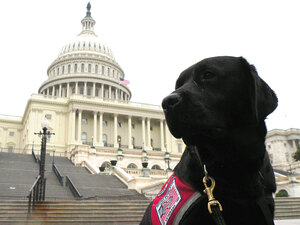
Putting Puppies Behind Bars? (No, It's A Good Thing!)


Of all the unlikely names for a nonprofit group, there may be none unlikelier than Puppies Behind Bars. But it's not what you might think.

The program teams puppies up with prison inmates — who live with and train the puppies to become bomb-sniffing dogs, or service dogs for wounded vets.

The program began at the Bedford Hills Correctional Facility in 1997. Now Puppies Behind Bars is working in six correctional facilities, and nearly 500 dogs have been trained in the program.

Gloria Gilbert Stoga, the nonprofit's founder and president, joins Fresh Air guest host Dave Davies for a conversation about Puppies Behind Bars and the people it serves.

Among them are Nora Moran, a former inmate who was part of the program; after she was released in January 2008, she took a job with Puppies Behind Bars.

Also joining the conversation is former Marine Cpl. Paul Bang-Knudsen. He was awarded a Purple Heart after an ambush in Iraq; he suffered multiple gunshot and shrapnel injuries and now suffers from post-traumatic stress disorder, or PTSD.

His dog, Samba — one of the first 10 dogs to graduate from the veterans companion animal program at Puppies Behind Bars — helps him get through the day, making him feel safe and alerting him to any potential surprises.

http://www.npr.org/templates/story/story.php?storyId=111806582

Marijuana, gateway drug to Jesus

Does pot lead to total enlightenment? Rehab? Scientology? Let's find out!

Behold! I believe I have found it, a flawless specimen, a place where it all collides and coheres and comes together in a madcap, slapdash, whirlwind hellstorm of entirely bogus hype and spin and half-truths, intermixed with hope and despair and Jesus and not just a little methadone, all of it so wonderful and confusing it makes you want to shut it all down, run a hot bath, light up a joint and chill the hell out.

It's all here. I even took a screenshot of it, just to show you. Two, actually. I'll link to them in a moment, because I really, really want you to see The Whole Truth, in all Its Profound Glory. Ready?

The first comes in the form a big study from the University of Pittsburgh, 12 years in the making, that valiantly attempts to answer, with some reasonable authority, the question that's already been answered pretty definitively by 500 million pot smokers throughout world history and also by every ounce of common sense in every commonsensical human alive today, but who cares about that now?

Here's the big question:

Is marijuana a gateway drug to harder, more dangerous 'n' deadly substances later in life? Did a bunch of kids who smoked pot in their teens go on to become addicts and criminals and Libertarians? Did they ruin their lives via meth and coke and sundry other delicious demons in anything resembling dangerous or enlightening percentages, enough that we could finally declare, once and for all, that pot really does lead to destruction and not, as so widely presumed, merely to kinkier sex and fits of uncontrollable laughter and the consumption of rather nauseating food combinations you would never entertain otherwise?

You already know the answer. Marijuana, it turns out for the billionth time, is not a gateway drug at all. Not even a little. Which is not to say excessive pot use throughout one's life is not a gateway to becoming, say, a bit of a slothful 'n' lumpish fan of unwashed dreadlocks and reggae festivals and bad pizza. But that's a different study.

GOOD: A Call for Entries!

New vaccine could save bees from colony collapse disorder

by Nitsana Bellehsen


Keeping our bee communities safe: Israeli company Beeologics may have the cure to the devastating disorder threatening bee populations worldwide. Photo by Nati Shohat / Flash 90.

An Israeli company has developed a revolutionary new drug that could solve the problem of Colony Collapse Disorder, the disturbing syndrome that has been wiping out bee communities and threatening agricultural production all over the world.

The drug, Remembee, which was developed by Beeologics, has completed successful clinical trials on millions of bees in North America. Not only has it proved effective in maintaining bee health, but it also improved the longevity of bees and increased the honey in the hives.

Based on Nobel prize-winning RNAI technology, Remembee helps the bees overcome IAVP virus, also discovered in Israel, which has been associated with colony collapse in scientific literature.

"It's really a tug of war between the virus and the host. We are helping the bee tug the rope more strongly and beat the virus. We take advantage of an immune system that the bees elicit for viral disease. But we are really using naturally occurring phenomenon. It's not a pesticide and it's not toxic," says Nitzan Paldi, CTO of Beeologics.

The US Department of Agriculture has been accompanying Beeologics with its FDA certification process due to the urgency of the need for the drug.

http://www.israel21c.org/index.php?option=com_content&view=article&id=6874:bee-colony-vaccine&catid=56:technology&Itemid=62

Tourism is alive and well in North Korea!

by Jane Stillwater

     Apparently North Korea, while not exactly having been the media darling of the U.S. press lately, is still encouraging tourism this year.  I just got an e-mail from my friend Hwa-young saying that she is offering several tours this September.  Hwa-young was the tour guide for the group that I went to the DPRK with last year and it was an amazing trip!  I recommend it highly.  If you liked the opening ceremonies to the Beijing Olympics, you will LOVE the Pyongyang Mass Games!  Here's the itinerary:

NORTH KOREA, THE RAREST and MOST EXTRAORDINARY OF CULTURAL TOURS, WELCOMES U.S. TOURISTS DURING THE WORLD-FAMOUS MASS GAMES!

Tourist testimonies repeatedly rate North Korea as one of the must-see highlights of world travel. It is the optimal cultural tour.  The Tour includes 2 nights/3 days in Beijing and 4 nights/5 days in DPRK.

The schedule is as follows:

1st day (Sundays):  Transportation from the Beijing airport to a 4 star hotel is provided.
 
2nd day (Mondays):  Tour of Beijing, China– Great Wall, Tiananmen Square and He Yuan [Imperial Palace]

3rd day(Tuesdays):  JS152 Flight Beijing - Pyongyang 11:30 departure, 14:25 arrival. Visit Arch of Triumph en-route to Mt. Myohyang – hike in the mountain.  Stay overnight at Hyangsan International Hotel (4 star) at the mountain.


4th day (Wednesdays): Visit International Friendship Exhibition Hall, Byohyon Temple.  Travel to Pyongyang to visit the Tower of Juche Idea, stone tower with lookout platform at the top and great views of the city, War Museum, ride the Pyongyang Metro with the locals, Mangyongdae School Children's Palace–see performance by the children.  Shopping at Stores.  Stay overnight at the Yanggakdo International Hotel (4 star).  [They gots a golf course, a bowling alley and a casino!]


5th day (Thursdays):  Grand Monument on Mansu Hill, Pyongyang Maternity Hospital, Kim Chaek Technical University, West Sea Barrage, stay overnight at the Ryonggang Hotel (with natural hot spring spa).

6th day (Fridays):  Visit Kaesong, DMZ, Koryo Museum, Tomb of King Wang Gwon, Pueblo, Arirang Mass Games.  Stay overnight Yanggakdo International Hotel.


7th day (Saturdays): JS151 flight Pyongyang-Beijing -- 08:55 departure 09:40 arrival.

What are the Mass Games?  http://www.youtube.com/watch?v=N9ZrP40wdlg
Over 100,000 performers, ranging from kindergartners to professional artists taking part in a gymnastic and artistic spectacle.  Theme this year: Self determination, Peace and Friendship.  This is a rare opportunity for a truly extraordinary experience.

     If you are interested, e-mail your name, sex, passport number, occupation and position, your home address, phone number to hwayounglee43@yahoo.com for DPRK visa process by above deadline dates.  If you have any questions please contact:  Hwa-young (Michelle) Lee


The official seal of the GOP