Tuesday, September 8, 2009

Toyota Prius Faces Ban Due to US Patent Suit

http://www.treehugger.com/images_site/bg-topper.gif

by Jaymi Heimbuch
prius rear bumper photo

Paice, a company that develops hybrid electric power train technology, has filed a patent infringement case against Toyota (yet again), saying that the company is using Paice's technology in the Prius and two other hybrid vehicles. Should Paice win, it could spell the death of certain vehicle imports, possibly including the green icon Prius.

According to Sam Eaton in an article from Marketplace, Paice claims Toyota's new Prius, hybrid Camry and two Lexus models are using technology Paice created. Back in 2005, the company won a claim against Toyota for this very infringement. That claim cost Toyota a whopping $4.3 million - $25 for every Prius, Highlander and Lexus RX400h sold using the disputed technology. It says Toyota is again using the same technology, and therefore has a fighting chance for this claim.

http://www.treehugger.com/files/2009/09/toyota-prius-faces-ban-due-to-us-patent-suit.php

Rebellious kids of conservatives

How Safe Is My FDIC-Insured Bank Account? Here is your answer.


by Chris Martenson
Your bank account may not be as safe as you think (or hope). Taking a deeper look at the legal details and the financial depth of the FDIC reveals several troubling details that call into question how the FDIC would fare during a true banking crisis.
The US is coming out of a period of unusually low banking stress and failures. Since it is typical human behavior to let one's guard down during tranquil periods, we might legitimately ask if this has happened with respect to the FDIC.
Before we address that, we need to understand bit more about the FDIC.

What is the FDIC?


Let's begin with a snippet from Wikipedia on the FDIC: 

The Federal Deposit Insurance Corporation (FDIC) is a United States government corporation created by the Glass-Steagall Act of 1933. The vast number of bank failures in the Great Depression spurred the United States Congress into creating an institution which would guarantee deposits held by commercial banks, inspired by the Commonwealth of Massachusetts and its Depositors Insurance Fund (DIF). The FDIC provides deposit insurance which currently guarantees checking and savings deposits in member banks up to $100,000 per depositor.

Accounts at different banks are insured separately. One person could keep $100,000 in accounts at two separate banks and be insured for a total of $200,000. Also, accounts in different ownerships (such as beneficial ownership, trusts, and joint accounts) can be considered separately for the $100,000 insurance limit. The Federal Deposit Insurance Reform Act raised the amount of insurance for an Individual Retirement Account to $250,000.

The two most common methods employed by FDIC in cases of insolvency or illiquidity are the:

• Payoff Method, in which insured deposits are paid by the FDIC, which attempts to recover its payments by liquidating the receivership estate of the failed bank.

• Purchase and Assumption Method, in which all deposits (liabilities) are assumed by an open bank, which also purchases some or all of the failed bank's loans (assets).
In short, if your bank gets in trouble, the FDIC will ride in and either pay off your account (up to $100k), or sell your bank off to another bank which will then assume the usual duties of your bank. Under normal circumstances, a bank failure should not impact you in the least. But these are not normal times. We might reasonably ask how the FDIC would respond during a major banking crisis. After all, this is our money we're talking about. Faith and hope are great at weddings and sporting events, but they should not form the basis of our strategy for handling our finances.

How many bank failures could the FDIC handle at once?

When we take a look at the financials of the FDIC (Figure 1) we see that the level of insurance (in circles below) is not terribly high either, when viewed as an aggregate amount (in blue) or on a percentage basis (in red). 

Figure 1.
 
The 1.22% Reserve Ratio means that for every dollar in your bank account, the FDIC has 1.22 cents "in reserve" ready to cover your potential losses. This has proved to be an ample amount during the period of stability we've recently had, but it doesn't seem particularly significant, considering the recent headlines about banking losses (Spring of 2008). 

Consider, for a moment, the collapse of Bear Stearns. In order to assume that bank, JP Morgan asked for, and received, a special waiver from the Federal Reserve to keep $400 billion of suspect of Bear Stearn's assets off the books of JPM (page 4 of the linked document). While JPM may have been padding the books a little bit here, due to the uncertainty of how bad the wreckage might turn out to be, $400 billion dwarfs the $52 billion reserves of the FDIC. 

If one medium-large bank collapse could wipe out the FDIC by a factor of nearly 8, what do you suppose would happen if there were multiple, simultaneous bank failures?
 
http://bluelori.blogspot.com/2009/09/how-safe-is-my-fdic-insured-bank.html

Justice Roberts' Big Test


By E.J. Dionne

WASHINGTON -- President Obama's health care speech on Wednesday will be only the second most consequential political moment of the week.

Judged by the standard of an event's potential long-term impact on our public life, the most important will be the argument before the Supreme Court (on the same day, as it happens) about a case that, if decided wrongly, could surrender control of our democracy to corporate interests.

This sounds melodramatic. It's not. The court is considering eviscerating laws that have been on the books since, in one case, 1907 and in the other, 1947 banning direct contributions and spending by corporations in federal election campaigns. Doing so would obliterate precedents that go back two and three decades.

The full impact of what the court could do in Citizens United v. Federal Election Commission has only begun to receive the attention it deserves. Even the word "radical" does not capture the extent to which the justices could turn our political system upside down. Will it use a case originally brought on a narrow issue to bring our politics back to the corruption of the Gilded Age?

Citizens United, a conservative group, brought suit arguing that it should be exempt from the restrictions of the 2002 McCain-Feingold campaign finance law for a movie it made that was sharply critical of Hillary Clinton. The organization said it should not have to disclose who financed the film.

Instead of deciding the case before it, the court engaged in a remarkable act of overreach. On June 29, it postponed a decision and called for new briefs and a highly unusual new hearing, which is Wednesday's big event. The court chose to consider an issue only tangentially raised by the case. It threatens to overrule a 1990 decision that upheld the long-standing ban on corporate money in campaigns.

I don't have the space to cite all the precedents the court would have to set aside, going back to the Buckley campaign finance ruling 1976, if it threw out the prohibition on corporate money. Suffice it to say that there is one member of the court who has spoken eloquently about the dangers of ignoring precedents.

"I do think that it is a jolt to the legal system when you overrule a precedent," he said. "Precedent plays an important role in promoting stability and evenhandedness. It is not enough -- and the court has emphasized this on several occasions -- it is not enough that you may think the prior decision was wrongly decided. That really doesn't answer the question, it just poses the question."

This careful jurist continued: "And you do look at these other factors, like settled expectations, like the legitimacy of the court, like whether a particular precedent is workable or not, whether a precedent has been eroded by subsequent developments."

He learnedly cited Alexander Hamilton who wrote in Federalist 78: "To avoid an arbitrary discretion in the judges, they need to be bound down by rules and precedents."

Chief Justice John Roberts, the likely swing vote in this case, was exactly right when he said these things during his 2005 confirmation hearings. If he uses his own standards, it is impossible to see how he can justify the use of "arbitrary discretion" to discard a well-established system whose construction began with the Tillman Act of 1907.

http://www.realclearpolitics.com/articles/2009/09/07/justice_roberts_big_test_98195.html

How To Respond To Right Wing Viral Emails

http://static.crooksandliars.com/sites/all/themes/crooks/crooksmain/images/header.jpg

My friends and family of the right wing persuasion have finally figured out to take me off their distribution lists for those viral emails that circulate about the internets. It was a lesson hard taught, because I felt obliged to obsessively research the facts and then reply to those emails, systematically destroying the wingnut talking points. You humiliate those wingnuts enough times, and they take you off their email lists.

Now, not everyone has the OCD to research and debunk these talking points, nor the need to be so...well, frankly, confrontational. So for people like that (you know, the ones much nicer than me), Media Matters has created an action site just for you. In it, they take some of the common viral emails--and then write responses to them, debunking the lies and very politely suggesting that the sender might want to use that gray matter lodged in his noggin for more than regurgitating Hannity. (I paraphrase, of course)

For example:

From: XXXXX@aol.com
To: XXXXXXXX@hotmail.com
Date: Saturday, August 01, 2009 6:18 AM
Subject: Fw: Senior's death warrant

SENIOR DEATH WARRANTS:

The actress Natasha Richardson died after falling skiing in Canada. It took eight hours to drive her to a hospital. If Canada had our healthcare she might be alive today. We now have helicopters that would have gotten her to the hospital in 30 minutes. Obama wants to have our healthcare like Canada's and England's.

In England anyone over 59 cannot receive heart repairs or stents or bypass because it is not covered as being too expensive and not needed.

I got this today and am sending it on. If Obama's plans in other areas don't scare you, this should.

Please do not let Obama sign senior death warrants.

Everybody that is on this mailing list is either a senior citizen, is getting close or knows somebody that is.

Most of you know by now that the Senate version (at least) of the "stimulus" Bill includes provisions for extensive rationing of health care for senior citizens.

The author of this part of the bill, former senator and tax evader, Tom Daschle was credited today by Bloomberg with the following statement.

Bloomberg: Daschle says "health-care reform will not be pain free. Seniors should be more accepting of the conditions that come with age instead of treating them."

If this does not sufficiently raise your ire, just remember that Senators and Congressmen have their own healthcare plan that is first dollar or very low co-pay which they are guaranteed the remainder of their lives and are not subject to this new law if it passes.

Please use the power of the Internet to get this message out. Talk it up at the grassroots level.... We have an election coming up in one year and nine months. We have the ability to Address and reverse the dangerous direction the Obama administration and it allies have begun and in the interim, we can make their lives miserable.

Lets do it! If you disagree, don't do anything.

Media Matters' response?

Hey, thanks for forwarding along that email.

It's nuts how many rumors are swirling around out there about the health bills. It's hard to know which ones are true and which ones are just crazy internet rumors.

If this one were true, I'd be pretty upset - so I decided to see if I could find out for myself.

It turns out Tom Daschle never even said that about "seniors should be more accepting of the conditions that come with age." Apparently that quote actually comes from a woman who is adamantly against any health care improvements named Betsy McCaughey. When a reporter confronted her about the chain email, even she admitted it wasn't true, saying "I regret any misrepresentations made by others of my work or Mr. Daschle's views."

You can read it yourself here: http://www.politifact.com/truth-o-meter/statements/2009/apr/03/chain-email/daschle-didnt-say-seniors-seniors-should-accept-ra/

As for Natasha Richardson, that was heartbreaking. I remember when I heard, I couldn't believe it! But the email lies about her already tragic situation.

It did take a while for her to visit a hospital, but that's because she initially said she wasn't hurt. A Bloomberg news story said "She initially laughed off her fall and said she was fine." And Fox News says the first ambulance that showed up was even turned away.

A few hours later she was taken to a hospital when she got a headache, but by then it was too late.

If you want to know more, you can read these articles: http://www.bloomberg.com/apps/news?pid=20601088&sid=aXuH_CcQz_Vs&refer=muse
http://www.foxnews.com/story/0,2933,509749,00.html

As for England, I found a cool website called FactCheck.org that examined the claim about "England anyone over 59 cannot receive heart repairs or stents or bypass because it is not covered as being too expensive and not needed." They said that just wasn't true.

But all of that should be irrelevant - because no one even wants Canada's health care system. The president and Democrats in congress know that we have been paying too much, for too long, for too little and are trying to find a "uniquely American solution" to control costs.

The same website actually shows that this entire email is pretty much made up, check it out: http://www.factcheck.org/2009/07/englands-and-canadas-health-care/

All these emails going around are pretty scary, but it's important to figure out if they're true. After doing some research, I can say for sure this one is filled with lies.

See? Much nicer than I would have been (and far fewer swear words), and yet, still getting the truth out there.

Go check out MM's Email Checker. If you've received a viral email that you don't see, you are welcome to send it to Media Matters so they can add it to their collection and give you a response.

http://crooksandliars.com/nicole-belle/how-respond-right-wing-viral-emails

Mario Savio: Sproul Hall Steps, December 2, 1964

Despite Slump, U.S. Role as Top Arms Supplier Grows

By THOM SHANKER

 
http://www.waronline.org/analysis/pal/weaponry.jpgWASHINGTON — Despite a recession that knocked down global arms sales last year, the United States expanded its role as the world's leading weapons supplier, increasing its share to more than two-thirds of all foreign armaments deals, according to a new Congressional study.

The United States signed weapons agreements valued at $37.8 billion in 2008, or 68.4 percent of all business in the global arms bazaar, up significantly from American sales of $25.4 billion the year before.

Italy was a distant second, with $3.7 billion in worldwide weapons sales in 2008, while Russia was third with $3.5 billion in arms sales last year — down considerably from the $10.8 billion in weapons deals signed by Moscow in 2007.

The growth in weapons sales by the United States last year was particularly noticeable against worldwide trends. The value of global arms sales in 2008 was $55.2 billion, a drop of 7.6 percent from 2007 and the lowest total for international weapons agreements since 2005.

http://www.nytimes.com/2009/09/07/world/07weapons.html?_r=1

New Rule

Monday, September 7, 2009

The Fast Food Mafia

The Myth of Technological Progress


Bullshit machine

Avatar for {name}Many of you will still be alive in 50 years. It's interesting to think about what life will be like in 50 years technologically and otherwise. Predictions are risky, especially when they're about the future, but I believe we can make some pretty good guesses. To predict a predictable future, you need to look at the past. What was technological life like 50 years ago? 50 years ago was 1959. The world of 1959 is pretty much the same world we live in today technologically speaking. This is a vaguely horrifying fact which is little appreciated. In 1959, we had computers, international telephony, advanced programming languages like Lisp, which remains the most advanced programming language, routine commercial jet flight, atomic power, internal combustion engines about the same as modern ones, supersonic fighter planes, television and the transistor.

I'd go so far as to say that the main technological innovation since 1959 has been space flight—a technology we've mostly abandoned, and it's daughter technology—microelectronics. Computer networks came a year or two after 1959 and didn't change very much, other than how we waste time in the office, and whom advertisers pay.

Other than that, man's power over nature remains much the same. Most of the "advances" we have had since then are refinements and democratization of technologies. Nowadays, even the little people have access to computers and jet flight, and 1800s-style technology like telegraphy can be used to download pornography into their homes. Certainly more people are involved in "technological" jobs, and certainly computers have increased our abilities to process information, but ultimately very little has changed.

Now, if we're sitting in unfashionable 1959 and doing this same comparison, things are a good deal different.

The rate of change between 1959 and 1909 is nothing short of spectacular. In that 50 years, humanity invented jet aircraft, supersonic flight, fuel-injected internal-combustion engines, the atomic bomb, the hydrogen bomb, space flight, gas warfare, nuclear power, the tank, antibiotics, the polio vaccine, radio; and these are just a few items off the top of my head. You might try to assert that this was a particularly good era for technological progress, but the era between 1859 and 1909 was a similar explosion in creativity and progress, as was the 50 years before that, at the dawn of the Industrial revolution. You can read all about it in Charles Murray's Human Accomplishment: The Pursuit of Excellence in the Arts and Sciences, 800 B.C. to 1950, though I warn you, if you're in a creative or technical profession Murray's widely ignored book is even more depressing than this essay. Murray didn't restrict his attentions to technological progress: across the entire panoply of human endeavor (art, science, literature, philosophy, Mathematics) the indications are grim. You may disagree with the statistical technique he used (I don't), but you can't escape the conclusion—things are slowing down. 

Certainly, people can be forgiven for thinking we live in a time of great progress, since semiconductor lithography has improved over the years, giving us faster and more portable computers. But can we really do anything with computers now that we couldn't have done 30 or even 50 years ago? I don't think life is much different because of ubiquitous computers. Possibly more efficient and convenient, but not radically different, much like things got after the invention of computers in the '40s. Now we just waste time in the office in different ways.

Remember the kind of "artificial intelligence" which was supposed to give us artificial brains we could talk to by now? The only parts of which work look suspiciously like signal processing ideas from, well, the 1950s. The rest of it appears to have degenerated into a sort of secular religion for nerds.

Looking forward, I can't think of a single technology in the works today which will revolutionize life in the 21st century. In the 1930s, there were dozens of obvious ones; you could read about them in magazines and science fiction. Now ... I don't know ... biotech. Maybe. Making insulin in toilet water is a neat trick, but all that really does is allow fat people to eat more sugar without slaughtering horses and pigs. I suppose some of the genetically engineered crops are impressive, though the birds-and-bunnies people tell me they are a bad idea. Some wise acre is likely to pipe up and sing the glories of "Nanotech," a "subject" which was "invented" in K. Eric Drexler's Ph.D. thesis in 1989. In the 20 years since he penned his fanciful little story, we have yet to see a single example of the wondrous miniature perpetual motion machines Drexler has been promising us "real soon now." I wonder what his timeline for delivery of this "technology" will be?

Presumably some time well after his retirement. I'll go out on a limb: since we don't even have computers that can program themselves in any useful fashion, the probability of anyone inventing self replicating miniature robots to give us magical powers (or any kind of powers) by 2059 is approximately zero. The very idea that we're banking on a glorious future ... powered by magical robotic germs seems to me a titanic failure in human imagination. Once upon a time, we dreamed about giant stately space dirigibles to bring us to strange new worlds. Drexler dreams about inventing mechanical bacteria.

Need more evidence? Let's look at aerospace. The SR-71 was designed in 1959. It took about two years to get the thing deployed, and it remains a faster jet than the F-22, which cost a lot more and took a lot longer to develope—first design was in 1986, first deployment in 1997. Sure, these aircraft aren't made to do the same thing, but there is little apparent progress here: both represent the best we've got of respective eras.

This is despite the fact that the SR-71 was mostly designed with a paper and slide rule, and the F-22 with the most modern CAD design technology. Perhaps you consider this a bad comparison? OK, let's consider the lowly passenger jet. The 747, a revolutionary passenger jet, was a concept in 1966. It was flying in 1968. The 787, which is not a revolutionary passenger jet, but one designed to be merely cheaper to operate, has been "in development" since 2004. It's now 2009, and still no 787s.

http://www.takimag.com/blogs/article/the_myth_of_technological_progress/

Fixed?

"Either the public buys the politicians or the special interests will."
-- George Skelton, LA Times 
Big Pharma makes sweetheart deals with the White House.

Big Oil sends employees to spoil congressional Town Halls with their assault rifles and their "grassroots" concerns about climate change.

Big Milk seizes the dairy industry (seriously). Last week NPR's John Burnett reported on two huge corporations which, ala Walmart, cow -- pun intended -- small independent farmers into selling their milk so cheaply, many are forced out of business. Bush Administration investigations against the two colossi evaporated.

Big Pharma, Big Oil, Big Milk. All special interest patrons of America's Big Money bordello. What are good progressives to do? Either we get lobotomies (not that recession-lashed activists can afford them) or we fix the way the country finances politics.

It was thrilling last month when 65 Congressional Reps refused to crumple on the public health insurance option. But as I wrote in my last post, to salvage representative democracy, voters must reclaim our electoral power.

We deserve a country where politicians value all constituents as highly as their largest donors, where people without fortunes -- or access to them -- get an equal shot at running for office. And there is progress.

Voter Owned Elections and Open and Ethical Elections Codes are two Clean Money/Elections systems succeeding throughout US states and cities. Competitors get enough public - clean -- money to challenge even lavishly-financed opponents, in exchange for strictly limiting the cash they accept from private sources.

No more having to spend 30 percent of their time begging corporations and wealthy donors for contributions and then voting the interests of these backers. Candidates are free to learn what's important to voters, and once elected, to serve everyone they represent.

After years of disgust with electoral politics, I began working in 2000 to bring Clean and Fair Elections (California Clean Money Campaign [CCMC]) here. How else can we end the ubiquity of the political quid pro quo?

The CA legislature stunned supporters last year by passing the California Fair Elections Act (CFEA). It designates one contest -- the campaign for Secretary of State -- as our clean money pilot project.

Why Secretary of State? Partly because this officeholder manages all federal and state elections within California. If any job needs to be free from even the palest trace of manipulation, this is it. Remember George W's victory linchpins, Secretaries of State Kathryn Harris, Florida, 2000, and Kenneth Blackwell, Ohio, 2004?

Also, the Secretary of State regulates the activities of lobbyists. Conflict of interest over-easy, anyone?

http://www.huffingtonpost.com/wendy-block/fixed_b_270123.html

The health insurance industy idolaters


Healthcare didn't have to go this way

Obama gave away the store on this crucial issue. It's time to take it back

By Joe Conason

NewsAchieving humane and affordable healthcare in America was never going to be easy, even with an audacious new president and large majorities in both houses of Congress. Compromise between the Democratic Party's diverse representatives -- let alone with the tiny handful of Republicans who actually care about the need for reform -- was always inevitable. And when the moment for compromise arrived, the result was certain to disappoint many of the president's most ardent voters, who cherished his campaign's promises of change. But the mundane grind of making legislation need not have been quite as painful as it is today, when progressives feel betrayed, and Democrats feel deflated. 

The essence of President Obama's problem can be found in an anonymous quote, attributed to a White House official, that appeared on the front page of the New York Times last Wednesday. "It's so important to get a deal," confided the unnamed aide, that the president "will do almost anything it takes to get one." Such desperate confessions of politics as usual, which have appeared in dozens of such remarks in the press over the past several months, not only serve the president poorly but damage the fresh brand that he brought to Washington after his triumphant election last year. They are the residue of an ill-conceived strategy that has left Obama politically vulnerable, attenuated his connection with loyal progressives, and blurred his most important message. 

That message was Obama himself, of course -- meaning what he represented and what he meant to accomplish. From the outset of the 2008 campaign, the rationale for his long-shot candidacy was that he stood firmly for a set of principles in policy and governance and against political business as usual, as well as a style of politics that emphasized citizen activism. He would drive the corporate lobbyists away from Capitol Hill, the White House and the federal agencies. He would insist on transparency and integrity in conducting the people's business. Above all, he would pursue the public interest forthrightly rather than inch forward triangularly and incrementally. 

Perhaps none of these happy promises was likely to be fulfilled, and perhaps that was something Obama and his campaign aides always understood. But as the new White House came to terms with the realities of Washington, they seem to have thrown off their original images and ideals insouciantly -- as if unburdening themselves of unfashionable baggage that embarrassed them in the big city. 

Nowhere has this fundamental mistake been more visible than in the effort to reform healthcare. From more than six decades of struggle over the question of universal coverage and cost control, the Obama team must have known that they would face enormous opposition. They should also have known, from the ugly mood of the Republican campaign during the final weeks of the election and the partisan history of the past 15 years, that chances for bipartisan agreement were minimal. And they ought to have realized that the energy of the progressive movement, expressed in their own campaign, could become their most formidable weapon in that battle. 

That was the insight attributed to FDR in a famous anecdote. When progressive leaders approached him with a wish list of reform programs and liberal legislation, he nodded. "I agree with you, I want to do it. Now make me do it." Although Roosevelt biographers consider that story apocryphal, it expresses a truth of political history that remained salient from the labor organizing of the Depression through the civil rights, antiwar, feminist and environmental movements. For a president who wants reform and change, citizen agitation is an important instrument of power, not an obstacle to deal making. 

http://www.salon.com/opinion/feature/2009/09/04/conason/

Why You Should Get Off Prescription Acid-Reducing Drugs ASAP!


heartburn, acid refluxTreatment with the anti-heartburn drugs known as proton pump inhibitors (PPIs) for eight weeks induces acid-related symptoms like heartburn, acid regurgitation and dyspepsia once treatment is withdrawn in healthy individuals, according to a new study.

More than 40 percent of healthy volunteers, who had never been bothered by heartburn, acid regurgitation or dyspepsia, developed such symptoms in the weeks after cessation of PPIs.

The use of PPIs for acid-related symptoms and disorders is extensive and rapidly escalating. Rebound acid hypersecretion, defined as an increase in gastric acid secretion above pre-treatment levels following antisecretory therapy, has been observed within two weeks after withdrawal of treatment and can lead to acid-related symptoms and possibly PPI dependency.

Sources:

Dr. Mercola''s CommentsDr. Mercola's Comments:

If you have heartburn, acid reflux, gastroesophageal reflux disease (GERD), peptic ulcer disease or any acid-related condition, chances are very high that you've been offered a prescription for a proton pump inhibitor (PPI)

PPIs like Prilosec, Nexium and Prevacid are among the most commonly prescribed drugs in the world, and their use for treating acid-related symptoms is increasing rapidly.

But these drugs are not only vastly overused … they're very dangerous as well.

To start, they actually CAUSE the very type of symptoms that they're intended to prevent if you stop taking them.

In the study above, more than 40 percent of healthy volunteers experienced heartburn, acid regurgitation and dyspepsia (pain and fullness in your abdomen) in the weeks after stopping the drugs. These were symptoms they did NOT have before!

It appears the drugs lead to "rebound acid hypersecretion," which is an increase in gastric acid secretion above pre-treatment levels within two weeks of stopping the drugs.

Essentially, because these drugs slam the brakes on the acid-producing pumps in your stomach, when you stop taking them that built-up acid can be unleashed with a vengeance.

http://articles.mercola.com/sites/articles/archive/2009/09/05/Why-You-Should-Get-Off-Prescription-Acid-Reducing-Drugs-ASAP.aspx

Why 'GQ' Doesn't Want Russians To Read Its Story

NPR

by David Folkenflik

For war journalist Scott Anderson, the most confounding part of his recent assignment for GQ magazine to explore the root of terrorist acts in Russia a decade ago wasn't the suggestion of treachery and subterfuge he found.

Scott Anderson, a veteran war correspondentIt was the reception his story ultimately received in the United States.

"It was quite mysterious to me," Anderson says. "All of a sudden, it became clear that they were going to run the article but they were going to try to bury it under a rock as much as they possibly could."

Anderson, 50, is an accomplished reporter and novelist who has written previously for Harper's Magazine, The New York Times Magazine, and Vanity Fair.

His investigative piece, published in the September American edition of GQ, challenges the official line on a series of bombings that killed hundreds of people in 1999 in Russia. It profiles a former KGB agent who spoke in great detail and on the record, at no small risk to himself. But instead of trumpeting his reporting, GQ's corporate owners went to extraordinary lengths to try to ensure no Russians will ever see it.

A Management Memo

Conde Nast owns Vanity Fair and GQ as well as other publications, including Russian versions of GQ, Glamour, Tatler and Vogue. On July 23, Jerry S. Birenz, one of the company's top lawyers, sent an e-mail memo to more than a dozen corporate executives and GQ editors.

"Conde Nast management has decided that the September issue of U.S. GQ magazine containing Scott Anderson's article 'Vladimir Putin's Dark Rise to Power' should not be distributed in Russia," Birenz wrote.

He ordered that the article could not be posted to the magazine's Web site. No copies of the American edition of the magazine could be sent to Russia or shown in any country to Russian government officials, journalists or advertisers. Additionally, the piece could not be published in other Conde Nast magazines abroad, nor publicized in any way.

It wasn't just that there was no reference to Anderson's piece on the cover of this month's GQ, which featured a picture of Michael Jackson, a reference to tennis star Andy Roddick's wife and a ranking of obnoxious colleges and top drinking cities. At this writing, I cannot find any reference to Anderson's piece on the Internet.

The idea that information can be sequestered at a time when people can communicate instantly across oceans and continents may seem quaint. But in this instance, Conde Nast sought, against technology, logic and the thrust of its own article, to show deference in the presence of power.

Lawyers, executives and editors at Conde Nast and GQ did not respond to repeated requests for comment this week, and a spokesman ultimately declined on their behalf. But NPR has spoken to several people knowledgeable about the handling of Anderson's piece. No issues have been raised to date about the article's accuracy.

http://www.npr.org/templates/story/story.php?storyId=112530364

For Teens, Has Texting Replaced Talking?

cellphone_art_257_20080929172612.jpg
Getty Images

I've always known my kids use digital communications gear a lot. But my cellphone bill last month really grabbed my attention.

My son had racked up nearly 2,000 incoming text messages, and had sent nearly as many. That means he was having more than 60 two-way communications via text message every day. Of course, he was out of school for the summer and communicating more with friends from a distance. Nevertheless, I had to wonder how he found time to hold down a summer job and complete a college course in between all that typing with his thumb.

I was even more surprised to learn that my son is normal. Teenagers with cellphones each send and receive 2,272 text messages a month on average, Nielsen Mobile says.

Some experts lament that all that keyboard jabber is making our kids stupid – unable to read nonverbal cues such as facial expressions, gestures, posture and other silent signals of mood and attitude. Unlike phones, text messaging doesn't even allow transmission of tone of voice or pauses, says Mark Bauerlein, author of a book called "The Dumbest Generation: How the Digital Age Stupefies Young Americans and Jeopardizes Our Future."

States are cracking down on drivers who text, and rightly so. My son doesn't text while driving, and we have discussed the dangers. (This graphic public service announcement, which has recently gone viral on YouTube, highlights just how dangerous texting while driving can be.)

Beyond that, though, I'm not sure I see as much harm as critics of this trend. I've posted before on how I initially tried to curb my kids' texting. But over time, I have seen my son suffer no apparent ill effects (except a sore thumb now and then), and he reaps a big benefit, of easy, continuing contact with many friends. Also, the time he spends texting replaces the hours teens used to spend on the phone; both my kids dislike talking on the phone, and say they really don't need to do so to stay in touch with friends and family.

Does texting make kids stupid? I don't think so. It may make them annoying, when they try to text and talk to you at the same time. And it may make them distracted, when buzzing text messages interrupt efforts to noodle out a calculus problem or finish reading for school.

But I don't see texting harming teens' ability to communicate. My son is as attuned to nonverbal cues as any older members of our family. If anything, I have found him more engaged and easier to communicate with from afar, because he is constantly available via text message and responds with a faithfulness and speed that any mother would find reassuring.

http://blogs.wsj.com/juggle/2009/09/03/for-teens-has-texting-replaced-talking/

Could Texas' Gingrich-Based High School History Curriculum Go National?

The GOP-controlled State Board of Education is working on a new set of statewide textbook standards for, among other subjects, U.S. History Studies Since Reconstruction. And it turns out what the board decides may end up having implications far beyond the Lone Star State.

The first draft of the standards, released at the end of July, is a doozy. It lays out a kind of Human Events version of U.S. history.

Approved textbooks, the standards say, must teach the Texan student to "identify significant conservative advocacy organizations and individuals, such as Newt Gingrich, Phyllis Schlafly, and the Moral Majority." No analogous liberal figures or groups are required, prompting protests from some legislators and committee members. (Read an excerpt here.)

The standards on Nixon: "describe Richard M. Nixon's role in the normalization of relations with China and the policy of detente."

On Reagan: "describe Ronald Reagan's role in restoring national confidence, such as Reaganomics and Peace with Strength." (That's it.)

The Cold War section is rendered as "U.S. responses to Soviet aggression after World War II ... "

The state board of education, made up of 10 Republicans and five Democrats, has to vote on the standards twice in the coming months before they would go into effect.

Comments in the margin of the draft explain the proposed changes. And a persistent, tendentious conservative voice comes through throughout. Next to the section listing key names and groups from the civil rights movement and 60s activism, including Martin Luther King, Betty Friedan, and the American Indian Movement, it's noted that a committee member demanded parity ... for late 20th century conservative groups:

MV[Multiple Views]: One person: inclusion of 7 names and organizations disproportionate compared to only 3 in conservative section.

Next to a noncontroversial seeming item requiring students to "describe how McCarthyism, the arms race, and the space race increased Cold War tensions" is the note:

"MV[Multiple Views]: One member thinks that if McCarthyism is noted, then the Venona papers need to be explained that exonerates him."

A bullet point on "women and minority employment" as an economic effect of World II caused "one member" to gripe "there is too much emphasis on multiculturalism."

And "one member" deemed a section on "effective leadership" a perfect place to bring to students' attention Charlton Heston's celebrated (among right-wingers) culture war speech.

Here's what makes this a national story: what happens in Texas doesn't stay in Texas, says Diane Ravitch, professor of education at NYU.

That's because Texas is one of the two states with the largest student enrollments, along with California. "The publishers vie to get their books adopted for them, and the changes that are inserted to please Texas and California are then part of the textbooks made available to every other state," says Ravitch, who wrote a book about the politics of textbooks.

Rick Hess of the American Enterprise Institute explains it as a simple economic calculation by the big textbook publishers. "Publishers are generally reticent to run two different versions of a textbook," he says. "You can imagine the headache the expense the logistics, the storage, all of it."

http://tpmmuckraker.talkingpointsmemo.com/2009/09/could_texas_gingrich_based_curriculum_go_national.php?ref=fpa

ALL THE WINE THAT'S FIT TO DRINK

by Jim Hightower

Newspapers are dead, we're told. Dinosaurs in a twittering world.

Well, try telling that to The New York Times. The Brontosaurus of American journalism, the largest newspaper in all the land, is not only alive – it intends to thrive!

Never mind that the paper's ad revenues have plummeted, that it has put some of its prime assets up for sale, and that its cash-flow situation is so dire that it sold a big chunk of itself this year to a Mexican billionaire known for shady dealings. Times are tough, even for the Times, but the company's innovative, forward-looking corporate leaders have come up with a business plan that they say will return the financial luster to gem of journalism. To make ends meet, the Times is going into wine.

Wine? You might presume that the executives have taken to guzzling wine in an effort to give the paper's future a rosy look – but, come on, these are serious business people. They have announced a new, revenue-enhancing venture called The New York Times Wine Club. For about $180 a month, the club will ship wine to your door.

At first blush, journalism and wine might seem an odd pairing. But the Times is already in the home-delivery business, so.... The head of "strategic planning" explains that a wine club is a way for the paper to "delve further into our audience and bring them products and services that basically enhance the bond with The New York Times." Whatever the hell that means.

Well, maybe it'll take odd jobs to keep the presses running. Actually, I think they're onto something with that home-delivery theme. Why not add The New York Times Maid Service to the mix? This would make the Times a company that could do it all for you in one stop – deliver your paper, clean your house, and leave a nice bottle of wine for you. See, there is a future in journalism!

Newspapers Fire Young People Most

alleyinsider

by Nicholas Carlson

shootinfoot tbi

Common sense would suggest that during this whole "death of print" era, newspapers would desperately cling to their young, idealistic and Internet-savvy employees who are willing to work for low entry-level wages.

But no.

According to a survey of newspaper editors, "workers between 18 and 35 years old represented the largest age group affected by [newspaper] layoffs, buyouts and attrition."

Reports the AP:

By MICHAEL LIEDTKE, AP Business Writer

SAN FRANCISCO (AP) — Cost-cutting newspapers are losing many of their youngest reporters, editors and photographers at the same time publishers are trying to break some of their old habits and learn new tricks on the Internet.

The findings emerged in a recent survey conducted by the Associated Press Managing Editors, an industry group. The report suggests the massive staff cuts at newspapers across the United States will make it even more difficult for the industry to adapt and remain relevant in the age of digital media.

Most of the 95 editors responding to the August survey said their newsroom staffs had shrunk by more than 10 percent during the past year. And workers between 18 and 35 years old represented the largest age group affected by the layoffs, buyouts and attrition, the survey found.

Retaining younger workers may be more important than ever as the Internet reshapes the way stories and photographs are assembled and presented. While many older journalists are adapting, the adjustment presumably isn't as difficult for younger workers who have grown up with the Internet and may have honed their digital skills in college. Having the viewpoints of younger workers also helps newspapers identify trends and issues affecting younger generations.

http://www.businessinsider.com/apme-survey-newspaper-cuts-clip-younger-workers-2009-8

Marvel/Disney Hybrids

When cartoon worlds collide.
 
Spider-Mouse
I'm not taking the Mickey...
Spider-Mouse by HIDDEN AUTHOR
 
Captain Donald
Captain Donald by HIDDEN AUTHOR
 
Genie Hulk SMASH!
 

Never lose hope


Wall Street To Securitize People’s Deaths?

 WAR ON YOU - Breaking News Without Corporate Views, Forum Message Board, Conspiracy Theories, Martial Law blog,

Source: CBFE Economics

The New York Times published a pretty creepy article on Saturday (September 5th). The article focuses on Wall Street's new plan to make money. What's so bad about Wall Street making money?

Well, their new plan is to buy life insurance plans from elderly and sick people for cash. The example that the New York Times gives is someone selling a million dollar policy for a $400,000 payout, but the payout amount would all depend on the seller's life expectancy. These "life settlements" would then be bundled together to form bonds that can be sold to investors. The investors would start paying for the person's policy from then on. When the person dies, the investors collect on the policy. Apparently, the faster the person dies, the more money the investors make. However, regardless of whether you die sooner or later, Wall Street firms will profit off of fees collected from creating the bonds and facilitating transactions. You could say that Wall Street is planning to "securitize" people's lives (or deaths, as it may be) into a kind of CDO. And we all know how great that whole CDO adventure played out for Wall Street, right? What could be dangerous about creating a similar class of financial products with sick people's life expectancy as the focus?

Apparently, these type of "life settlement" investments aren't new for banks. They already exist in a lot of portfolios. What's new is the plan to securitize these "life settlements" and market them as a big-time asset class of their own. Keep in mind, this isn't something banks are just talking about potentially doing. The Times states that Credit Suisse is "building a financial assembly line to buy large numbers of life insurance policies, package and resell them — just as Wall Street firms did with subprime securities." Estimates are putting the market for this class of investment product at $500 Billion, according to the article. I don't doubt it one bit. Considering how many people are losing their jobs or facing pay cuts and how high medical bills are these days, does anyone really doubt that there are a whole lot of elderly and sick people out there who would be eager to sell their life insurance policies for an immediate cash payout? Especially if they foresee a future inability to pay their premiums?

So what's the upside? Right now a lot of people just let their life insurance policies lapse. If they're lucky they'll still get a small payout but its usually not much compared to the premiums they've paid up to that point. Under this "life settlement" proposal, policy sellers get a bigger payout and eventually investors get their payout too. So insurance companies end up paying out on their policies more often than they do now. But, insurance companies could end up just raising rates and premiums to make up for the difference, which could end up leaving the average policyholder worse off. Wall Street profits. Insurance companies profit. The consumer pays up.

Still, its hard to really get that angry over a proposal like this. As I pointed out, these type of "life settlements" are already held in a lot of investment bank portfolios. And, who am I to say what kind of financial relationships elderly and sick people should or shouldn't engage in?

But there are so many disturbing ramifications that come out of this proposal that I can't help but be worried. The article mentions that investors lost out on these type of investments in the '80s when people with AIDS ended up living longer thanks to new medications. It also mentions that risk managers are planning on diversifying these bonds based on illness type. If one bond happens to represent too many people who all have one type of illness, then that bond could prove to be unprofitable if a cure for that illness is ever discovered. Am I the only one who finds it disturbing that it'll now be in the interest of some Wall Street investors for sick and old to people to die faster and for certain medications or medical procedures to be suppressed or kept inaccessible to the public if they're too successful at actually making people live longer? I mean, don't some of these major banks also have large stakes in pharmaceutical and healthcare companies? Couldn't that present a very serious and disturbing conflict of interest? The article doesn't address these questions.

Then there's this:

Goldman Sachs has developed a tradable index of life settlements, enabling investors to bet on whether people will live longer than expected or die sooner than planned. The index is similar to tradable stock market indices that allow investors to bet on the overall direction of the market without buying stocks.

So, not only will investors be making money when some people die but some investors will also be making money by simply placing bets on life expectancy in a kind of virtual market. Great. Thank God we bailed out these banks, otherwise they wouldn't have been able to come up with these great investment products that will surely work to make America more economically competitive with the rest of the globe.

http://waronyou.com/topics/wall-street-to-securitize-peoples-deaths/

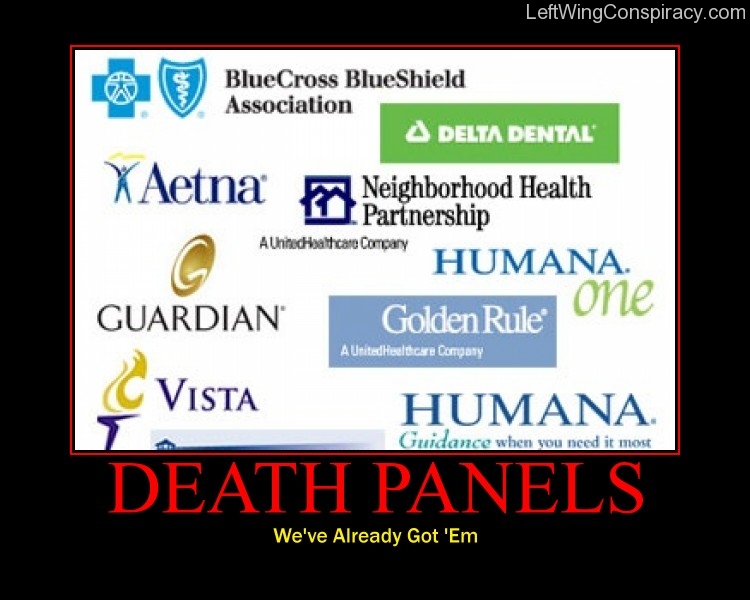
Death Panels: We've already got 'em


Motivational Poster -- Death Panels

Friday, September 4, 2009

Poor people will never die

The fate of Obama's presidency

It hinges on the economy, which is slowly recovering, and Afghanistan, which is fatefully resembling Vietnam.

Two issues in national politics determine the fate of presidencies: the state of the national economy and the status of overseas wars. Thus, although media attention presently centers on President Obama's scheduled speech next week to the Congress regarding his endangered health-care initiative, his administration's future — and that of congressional candidates, in both parties, running in 2010 elections — will depend far more greatly on the economic and foreign-policy fundamentals.

First, a brief word about the health-care issue. Obama, quite late in the game, seems to have realized that he can no longer remain a spectator in the formulation of a final health-reform plan, leaving it to Democratic congressional chairs to shape. He is reported to be preparing a definitive statement for his congressional appearance in which he will spell out exactly those provisions he wants enacted in 2009.

Turmoil will follow. Congressional Democrats, in particular, will be enraged if Obama drops the so-called "public option," which would create a public health-insurance plan to compete with private plans. But, in the end, some kind of legislation can be passed this year labeled "health-care reform." It probably will involve marginal insurance-market changes.

Now to the Big Two issues.

Despite the recent upward surge in the Dow index, the outlook for financial and economic recovery remains cloudy. Some indices point upward. But medium-sized and small banks keep going under, including in this region — not because of exotic derivatives but because bread-and-butter construction and business loans have gone bad in regions hard hit by the recession.

Meantime, public debt keeps mounting as a result of the financial and auto-industry bailouts, the stimulus package, and the cost of continuing interventions in Iraq and Afghanistan. The Federal Reserve, not wanting to quash recovery, will continue its present easy monetary policy. But, down the road, the accumulating debt will lead to inflation and the Fed will have to tighten.

The consensus view among economists, which seems the correct one at this point, is that financial/economic recovery will come gradually over the remainder of this year and in 2010. Unemployment rates will remain high, however, and probably not begin to come noticeably down until late next year (when, coincidentally, off-year elections will be held). Fed tightening is unlikely to take place until sometime in 2011.

Now, about those offshore wars. Former University of Washington President Bill Gerberding circulated to friends last week a memorandum questioning whether the U.S. involvement in Afghanistan was beginning to resemble that in Vietnam. The Seattle Times, living on the financial edge, decided to spend money to send reporter Hal Bernton to Afghanistan for two months to give local readers first-hand coverage of the war there. These are local expressions of growing national concern about Afghanistan.

A broad national poll at the beginning of this week showed that most Democrats already have turned against the Afghanistan commitment, which Obama has said was necessary, while independent voters are trending that way. Only Republicans continue to give strong majority support to the U.S. effort there. (This creates an irony. Obama draws Democrats-only support for his health-reform legislation, while he draws mainly GOP support for his commitment to Afghanistan.) Even while national media coverage focuses on health-care reform and the economy, Afghanistan coverage is beginning to equal it — especially in the wake of the disputed and chaotic recent national election there.

Reportedly, a debate is taking place within the Obama administration about Afghanistan policy from this point forward. Vice President Joe Biden is said to be arguing for an exit strategy tied to a deal with the Taliban. At this point, State and Defense remain committed to staying the course toward the creation of a stable Afghanistan in which the Taliban and Al Qaida cannot regain an important foothold. Meantime, ground commanders keep requesting increased troop levels.

As Gerberding's memo pointed out, this is about where we were in Vietnam policy when President Johnson kept increasing U.S. troop levels in response to Pentagon requests for same.

http://crosscut.com/2009/09/04/politics-government/19212/

Being smart really is sexy

Brainy men really are the sexiest, claim scientists who have discovered a link between intelligence and virility.

Man wearing spectacles, glasses: Being smart really is sexyPsychologists have found that men with the highest IQ also have the healthiest sperm.

The findings could explain why some of the world's most intelligent men have so many female admirers no matter their physical attractiveness.

They also suggest that being smart and funny might have developed as a signal to women looking for a mate with healthy genes.

The research, by the evolutionary psychologist Professor Geoffrey Miller of the University of New Mexico, centred around a study of 400 Vietnam War veterans who were put through extensive mental tests and were also asked to provide sperm samples.

According to the test results, it was found that men who scored high on a battery of intelligence tests boasted high counts of healthy sperm.

Whereas, low scorers tended to have fewer and more sickly sperm.

Professor Miller, who is speaking at a conference of the Association for the Study of Animal Behaviour at Oxford University, believes that sperm quality was directly related to brain quality.

The two traits could have evolved together as a way to advertise good genes, he said.

He believes a number of human traits – including language, intelligence, humour and selflessness – may have evolved because they are attractive to the opposite sex.

http://www.telegraph.co.uk/science/6126492/Being-smart-really-is-sexy.html

DUI attorney challenges laws prohibiting driving while stoned

By Stephen C. Webster

Is driving while under the influence of THC, one of marijuana's active ingredients, actually dangerous? One prominent California DUI attorney believes it is not nearly as dangerous as driving drunk and has issued a challenge to laws that punish marijuana users who get behind the wheel.

San Diego defense attorney Lawrence Taylor, considered "The Dean of DUI Attorneys," according to a release by his firm, is apparently arguing that DUI laws are unfair because they do not allow consideration for the varying degrees of inebriation caused by drugs of abuse.

Drivers convicted of marijuana intoxication are usually sentenced only after authorities have taken a blood sample. However that blood sample, he notes, only measures the body's metabolism of marijuana's compounds, not the actual level of impairment.

Evidence of marijuana use can remain in the human body for weeks or or longer, as it has been shown to latch on to fat cells, causing some inactive users to fail drug tests after a period of weight loss. For drivers accused of operating a vehicle while stoned, the presence of blood test results showing recent marijuana consumption can become a tricky legal hurdle.

In an advisory circulated through PRNewswire, Taylor cites two recent federal studies which concluded driving stoned is less dangerous than driving drunk, particular for more experienced marijuana users.

http://rawstory.com/08/news/2009/09/03/dui-attorney-challenges-laws-prohibiting-driving-while-stoned/

No thumbprint, no money, bank tells armless man

Reuters

MIAMI (Reuters) – A bank in Florida refused to cash a check for an armless man because he could not provide a thumbprint.

"They looked at my prosthetic hands and the teller said, 'Well, obviously you can't give us a thumbprint'," Steve Valdez told CNN on Wednesday.

But he said the Bank of America Corp branch in downtown Tampa, Florida, still insisted on a thumbprint identification for him to cash a check drawn on his wife's account at the bank, even though he showed them two photo IDs.

In the incident last week, a bank supervisor told Valdez he could only cash the check without a thumbprint if he brought his wife in with him or he opened an account with them.

"I told them I neither wanted an account with them and couldn't bring my wife in because she was nowhere close by," Valdez told CNN.

http://news.yahoo.com/s/nm/20090903/us_nm/us_bank_thumbprint

Gus Porter, American Legend with Thomas Haden Church

Gus Porter gets mauled by a bear, but he won't let the socialist Canadian health care fix him up, so he'll hike back to America.
 

A Look At The Labor Movement in Iran

In Iran, a corrupt and theocratic regime has made life extremely difficult for workers, the poor, and for the great majority of the country's citizens. Almost 50 percent of the population lives below the poverty line; the unemployment rate is about 20 percent, more than 1,500 factories have closed, and inflation runs around 30 percent, in part due to mismanagement of the budget by Mahmoud Ahmadinejad's government. At the same time, the country has undergone increased privatization in which state firms are sold—underpriced—to those with connections to the regime's insiders, among them the rich and powerful. As a result, the country's wealth is being redistributed, mainly in favor of a tiny minority. The richest 10 percent of the population has 21 times more income than those in the lowest 10 percent.

In the last 30 years, the clerical rulers and their economic partners in the traditional commerce centers (bazaars) have brutally suppressed the legitimate emancipatory and economic demands of the people, particularly the poor, the working class, women, and youth. These oppressors have been joined by security/military members whose organizations either own major financial firms or exert control on the basis of "friendly" privatization of previously state-run economic institutions.

In the recent mass demonstrations against the presidential election results (apparently rigged in favor of Mahmoud Ahmadinejad, with the support of Ali Khamenei, the religious supreme leader), the Revolutionary Guards and Paramilitary Basiji participated in the violent attacks against the protestors. In fact, in the past 30 years, the regime has been able to suppress dissidents and periodic uprisings by consistently playing the "anti-imperialist," nationalist card and using populist-religious propaganda. As a last resort, it does not hesitate to violently repress any mass resistance.

In the meantime, the Iranian people have never stopped their resistance, striving for freedom, democracy, social justice, and the right of social self-determination. The labor movement has long fought for its rights. In the first months of the 1979 revolution, workers organized labor councils and seized some factories and institutions. Soon, however, political repression began and these labor activists, along with progressive and socialist individuals and groups, were violently suppressed. Thereafter, regime-sponsored labor centers and institutions, such as the Worker's House and Islamic Labor Councils (ILCs), were installed to control workers. Under Iranian labor law, these councils can be set up in companies with more than 50 workers. Their objectives are to "propagate and spread Islamic culture and defend the achievement of the Islamic Revolution."

In the past few years, labor activists have organized independent unions. Their efforts have been a response to privatization, in which new owners, searching for quick profits, closed down many companies. That, in turn, caused a dramatic increase in layoffs and difficult conditions for workers, who endured longer periods of pay delays and forced temporary employment at lower wages.

http://www.zcommunications.org/zmag/viewArticle/22392

Six lobbyists per lawmaker enough on health care?


FROM CNN's Jack Cafferty:

Want to know why they're having trouble getting health care reform passed in Washington? Consider this: There are six…. count 'em — six, lobbyists for each of the 535 members of Congress.

This translates to 3,300 lobbyists working on health care — or three times the number who lobby on defense. These groups reportedly spent more than $263 million on lobbying during the first six months of this year — with drug makers alone spending more than $134 million.

One expert tells Bloomberg news: "The sheer quantity of money that's sloshed around Washington is drowning out the voices of citizens and the groups that speak up for them."

And let's talk about that money for a minute. According to The Center for Responsive Politics, health-related companies gave almost $170 million to federal lawmakers in 2007 and 2008.

Max Baucus — chairman of the Senate Finance Committee — got $3 million from the health and insurance industries from 2003 – 2008.

The ranking Republican on that committee, Sen. Chuck Grassley, took in more than $2 million since 2003.

Over in the House — Ways and Means Chairman Charlie Rangel received $1.6 million from the health sector and its employees in the last two years. And ranking Republican Dave Camp received almost $1 million in that time.

And this is just a few of them.

Here's my question to you: When it comes to health care reform, are six lobbyists for each member of Congress enough?

http://caffertyfile.blogs.cnn.com/2009/09/03/six-lobbyists-per-lawmaker-enough-on-health-care/